
TAKE, EAT…

The title of this exhibition is meant to imply the central, interactive role of art in our lives even on the primitive level of survival’ – and conversely the role of life in shaping the multiple meanings which originate in the field of art.
Art today is redefining its presence and existence as a ‘continuum’ of everyday life, while often it is distinguished and differentiated only in the context/within the bounds of a museum or art gallery.
The general destabilisation of new structures of power, authority and social relations produces and reproduces to a superlative degree hybrid forms and almost ‘perversely dislocated meanings The world of automation, of prefabricated images, of cloned idols and easy compromises is a fatal threat to our psychic equilibrium and identity, our contact with our own body and those of others.
In the last quarter of the twentieth century our psychic identity has been shattered, our relations with meaning disrupted, our imagination ostracised and our mental space contracted. The contemporary individual is threatened with loss of his psychic space which is not only the life of the intellect but also incorporates what Julia Kristeva has called ‘experience, which as a concept embraces thought, feeling, sexuality and imagination. The problem today is one of representation, and the symptom of our time is the passage into praxis. It is aesthetic experience which perceives and represents, through everyday life, this passage from passion to meaning1.
Through his handling of the technical (constructional-gestural) and social-conceptual aspects of art (works which suggest the myths and narratives of utopian political systems) Dimitris Xonoglou now approaches, through a multi-dimensional installation, the passage from impulse to re-presentation, from passion to meaning, as well as the fundamental role of the Symbolic, which opens his work to the whole field of the consecrated, the realms of imagination and subjectivity. This bold and perilous enterprise entails a sacrifice, by its very definition a sacred act. The sacred must, of course, be experienced in private terms – as the sequel and counterpoint to primitive rites. It has been revealed to us as that which endows with meaning the most personal of qualities, at the crossroads of body and thought, biology and memory, life and meaning – in both men and women2.
In the early 20th century criticism of the social subject, as it evolves through contradictions in social order, nationality and race, and the critical stance towards and interpretation of authenticity (of the work of art), were expressed through a strategy of assimilation of the real, reflecting the profound crisis of modernism, mirrored in its post-modern, fragmented and chaotic identity. The theory of post-modernism involves the death of the grand narratives’, those which belonged to eras characterised by a sensus communis, in contrast to the contemporary acceptance of absence, through pluralism and diversity. In contrast to the avant-garde movements of the early 20th century, with their utopian and revolutionary demands, the Pop Art of the 1980s was identified with a ‘democratic’ and modern culture, one driven by strategies of consumption, acivertisement and the spectacle.
In the globalised, multicultural world of the 1990’s, the new post-modern culture is analysed acutely by the artist and set in opposition to current social and political reality. The “grand narratives’ and democratised spectacle of Pop Art are re-defined through radical trends, attitudes and behaviour. Artists now tackle crucial anthropological, sociological, cultural and archetypal issues, opposed to the self referentiality of the aesthetic language, which confines the morphological strategies and the signified messages of the work of art.
This change of perspective in the contemporary aesthetic approach of the work of art coincides with the integration of personal points of reference (autobiography) and specific experiences – linguistic, ethno cultural and historical phenomena – which are the driving forces behind the emergence of new ‘grand narratives’. According to Arthur Danto, “an “authentic” contemporary understanding of art and culture is based on the conception and appreciation of a social and ethno-cultural “multiplicity of identities”. In this complex diffusion of identities, the artist freely asserts his own “biographical” identity as a legitimate and established complex, able to support his own personal aesthetic strategies, moving within specific frameworks’. As part of this pluralistic, globalised system, Dimitris Xonoglou moves both within and beyond its borders, accepting the challenge of ‘intellectual exile’ as he develops his personal and artistic systems, open to both socio-cultural and anthropological constants and to desires, obsessions and autobiographical data. Against the rigorously monolithic linearity and self-referentiality of specific formalistic systems, he aligns himself – through his anti-hierarchical artistic stance – in favour of the contemporary approach to the ‘grand narrative”
The progress of an exhibition: Take, eat…
First room / Antechamber / Reception. Reversal of the given.
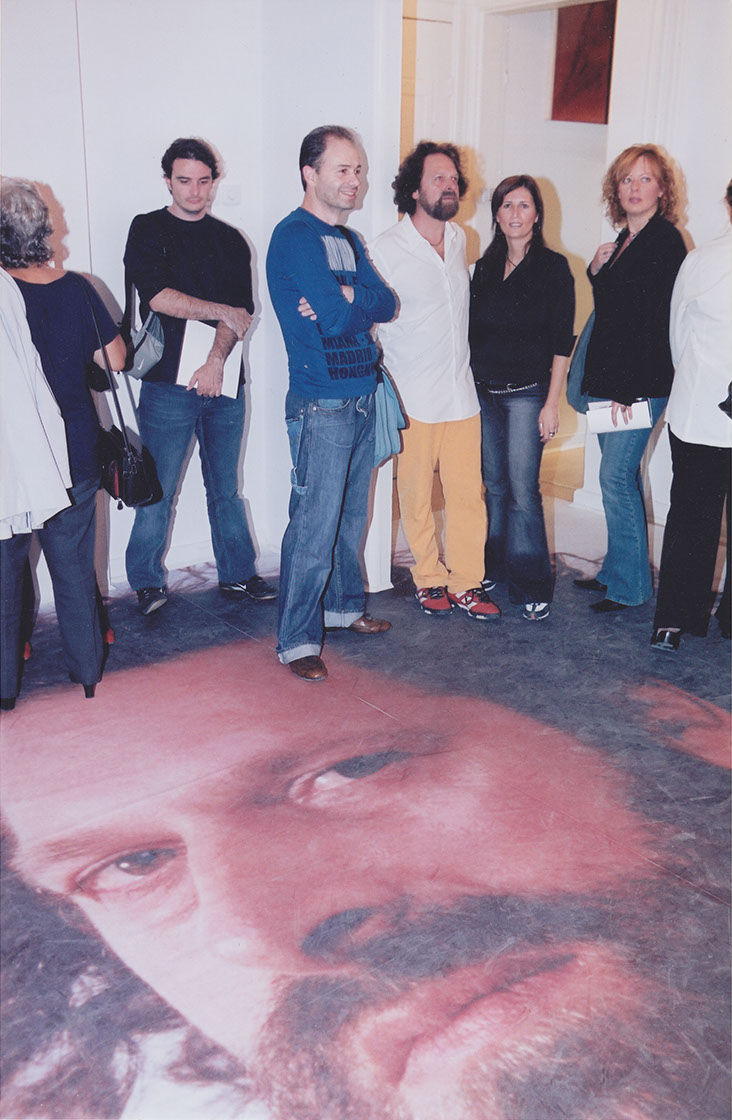
The pre-determined, defined space of the gallery is transformed. The visitor is invited to walk across the face of the artist. The artist offers and is offered. The conventional framework and boundaries of the exhibition are turned upside down. The self-portrait of the artist is not displayed in the usual frontal position (hung conventionally on the gallery wall) but instead spread out assertively and impulsively across the gallery floor, a conscious gesture of profanity and sacrilege. The sculptural installation (table, chair, ceramic plates) suspended on the wall is displayed and exhibited as an ‘anti-ready made’ sculptural object, gesturally constructed to precise, rigorously mathematical proportions. Self-referentiality is abolished Xonoglou’s system of cultural anthropology surpasses the subversive model of Marcel Duchamp, in favour of a specific reality with transcendental potential. These apparently ‘frozen’ objects, beautifully constructed (numbers and proportions play a key role here) challenge our senses and hint at symbolic levels of interpretation. Their technical quality (closed, defined form) and ostensibly detached identity imply an aggressive self-mocking, the linear ‘mechanical’, static and austere rhythm/placing, charged with emotion (the red color reinforces the sense of powerful feeling), underline the ritual character of the installation, the sense of a concealed consecration, a dramatised, theatrical dimension, The objects themselves, devoid of meaning, evoke emotional and anthropological concepts. their presence as if staged, anxiously promoting the process of seeking and asserting artistic identity itself.
Faced with this severe and abstract globalised hierarchy, Xonoglou explores the anthropological and ethno-cultural fields of reality, heterogeneity and the coexistence of different value systems, such as those generated by the diachronic, archetypal polarities of beauty and ugliness, the sacred and profane, the familiar and the strange, individuality and collectivity, the rational and the absurd. This apparently ‘indifferent juxtaposition of familiar functional objects from different sociopolitical and geographical communities reinforces the refusal of the abstract, monolithic and non-historical system of expression and interpretation. Instead the artist takes his stand under the banner of daring new ideas, Which he forces to extremes, to the point of the absurd. The selection, arrangement and exhibition of the objects is interpreted as a contemporary ritual act, its implicit asceticism not defined as a gesture of defiance to the material world, such as we see in Constructivism and Conceptual Art, but rather as an animation of the everyday, a ‘genuine’ cult of the familiar – which in its turn can be assimilated to the strange. Symbolic thought has always been an integral part of the essentially human. The physical ’emptiness’ of the object is transformed into fullness through the ritual gesture of the artist, rendered through his desires and behaviour. Displayed in a state of hieratic suspension, the sculptural installation does not attempt to deny its own functionality – and at the same time its identity as symbol or emblem (the red of sacrifice, of revolt, of passion, the Last Supper, a table for feasting, for sacrifice, for communion, communication – even a still life or “vanitas”). Every element responds to a given need, every element fulfils multiple functions.
Second room
The little house. The alphabet of life.
Constructed of little pieces of compressed bread (assembled like the pieces in a Lego set) the little house issues an insistent evocation of an endlessly repeated action – the feeding of a young child. Bread itself, a central element in our diet, creates the cycle of life, growth, the alpha and omega, speech, knowledge, proportion, communication, holy communion.
The house, with all its connotations of home, hearth and refuge, is exhibited here as a nucleus or microcosm, safeguarding the concept of time. ‘Time as both context and content, idea and divine personality, the property of various gods, is one of the most powerful catalysts in revelation of the underlying designs behind the diachronic schools of the spirit and the intellect3. Opposed to the world of organic life is mechanical, technological time (video), which is cancelled through its own dimension and management, in a world where reality is manifested as essentially contradictory.
The fish room
Through the ‘traditional’ medium of paint, Xonoglou reverses the fish image, rendering it in proliferating spasms of colour. These are not images of psychological flight, “biblical’ nostalgia, or the conception of an archetypal form. They are much-loved conceptual schemata, projected impressions, nuances of thought, experiences of touch and experienced periodicity. They are rhythmical, recurrent exercises, like the endless revolving dances of the dervishes. In contrast the fragments of the broken plate suspended on the wall – both testimony and concealment – remind us of their own inner void: food in its primary sense of gift and pleasure, now offered us in processed, decorative form – like the minimal adornment of the giant plate or frame.
Dr. Sania Papa
Art Theorist
Director of Thessaloniki Contemporary Art Centre
Thessaloniki, October 2004
[1] Julia Kristeva, Les Nouvelles maladies de l’ame. Kastaniotis, Athens 1998, p.10.
[2] Catherine Clément, Julia Kristeva, Le Féminin et le Sacré, Psychoyios, Athens 2001, p. 286.
[3] Mircea Eliade, Images et Sympoles. Essais sur le symnolisme magico-réligieux, Arsinidis, Athens 1991, p. 10.